
Why ChatGPT Can’t Replace Your Accountant
We’re not living in the dark ages anymore. The 2000s are long gone. No more dial-up screeching its approval as you tiptoe into the mystical land of the internet. Today, we live in a fast-paced world where answers to almost anything are just a tap away. But with instant answers comes the pressure to respond just as quickly. Life has sped up. That’s where AI steps in and in particular, ChatGPT.
And yes, ChatGPT is incredible. We asked it to write a poem about tax returns, and in less than a second, it delivered:
There once was a taxpayer named Lee
Who filed with precision and glee
No deadline was missed
No figures dismissed
Now HMRC leaves him be
Brilliant. With tools like this at your fingertips, it’s easy to feel like you can do it all, including DIY finances. Look, we’re under no illusions… ChatGPT and its competitors are useful. But we also know, from experience, why you’d be wise to take AI’s advice with a pinch of salt.
What AI Can Do
Accountancy is full of jargon and acronyms. Let’s use “accruals” as an example as it’s a term that often trips people up. The ACCA defines it like this:
“Accrual accounting depicts the effects of transactions and other events and circumstances on a reporting entity’s economic resources and claims in the periods in which those effects occur, even if the resulting cash receipts and payments occur in a different period.”
A bit of a mouthful to say the least. So, we asked ChatGPT to explain it to a five-year-old:
‘Imagine you had a birthday party last week. You ordered a bouncy castle, but the person who brought it hasn’t sent you the bill yet. Even though you haven’t paid, you still used the bouncy castle—so we write it down as something you owe.
Now imagine your friend promised to bring you a box of donuts next week because you helped them tidy up. You haven’t got the donuts yet, but you know they’re coming—so we write it down as something you’ll get.
That’s what accruals are: writing down things you used or earned, even if the money hasn’t moved yet. It’s like keeping score so everything adds up properly.’
This is where ChatGPT shines. It can explain complex ideas in simple, digestible ways. It can also help you draft emails, brainstorm ideas, and give general overviews of tricky topics. What it can’t do is extrapolate your broad prompt to more specific rules, regulations and financial quirks. It doesn’t know you or your business. And that’s where things get tricky.
What AI Can’t Do

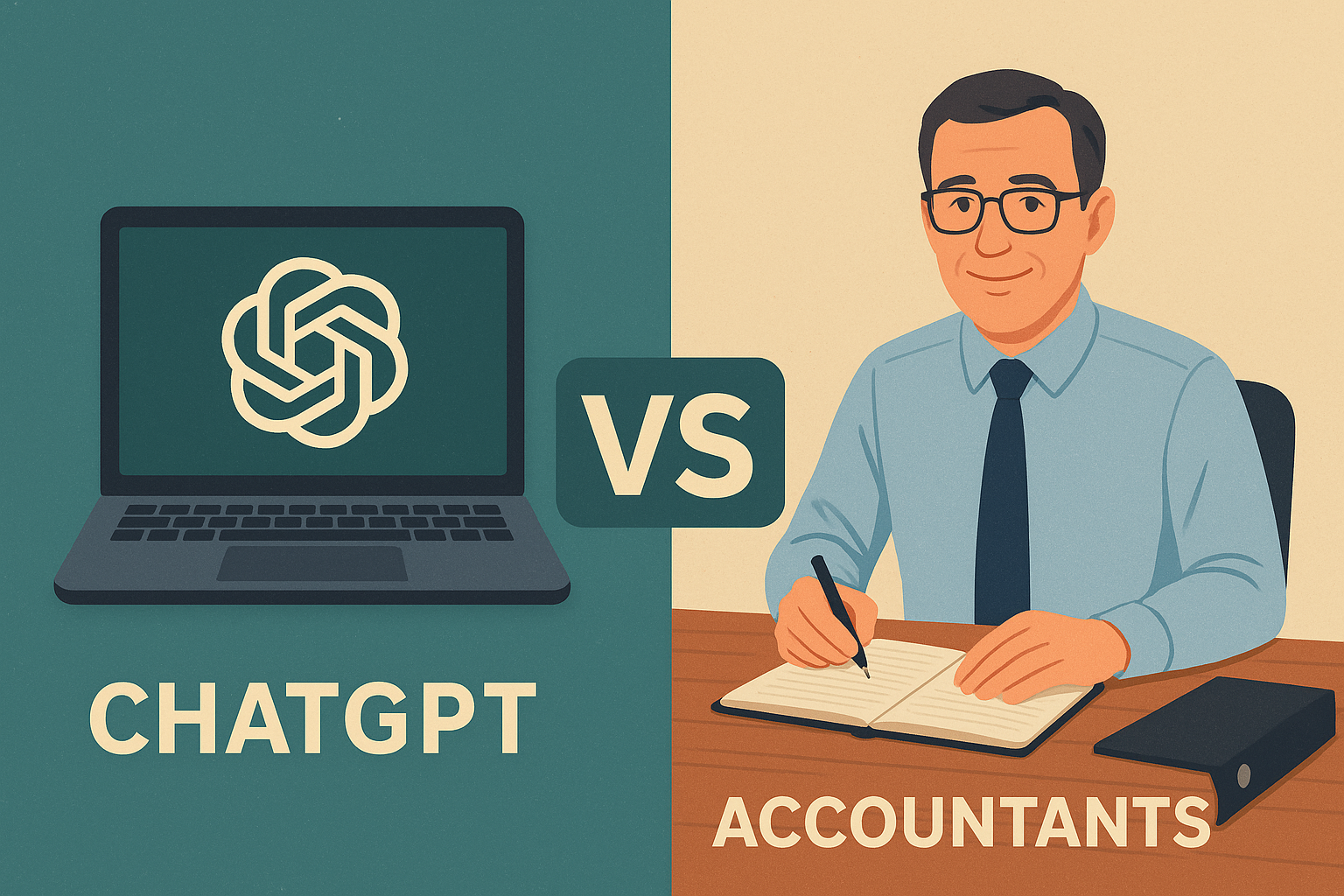
This is what ChatGPT thinks an accountant looks like.
It’s spot the stereotype. Firstly, it’s male which reflects its bias as research found that 56% of accounting students in the world were female in 2023*.
AI doesn’t know you. It makes assumptions based on the prompt you type into the box.
It has no idea what your goals are, whether you want to expand, pull back, or keep your finances steady. In short, it can’t know or understand you the way another human can (especially in conversation over a coffee and cake!)
Have you ever asked AI a loaded question? It’s inclined to agree with you. From personal experience, it tends to mirror the tone and feeling it takes from your prompt.
Your accountant, on the other hand, is trained to look at the numbers and see what they tell us. Is the cash flow healthy? Should I invest in growing my businesss? Sometimes, this means giving advice to improve business functionality and that’s not something AI can achieve yet.
Building a Relationship
Many accountants, especially local ones, pride themselves on building trust with their clients. Long-term relationships mean we know exactly what businesses and individuals need to succeed.
It might sound strange coming from an accountant, but it’s not just about the numbers either. It’s just as important for us to make sure you are comfortable with your work-life balance and that you’re looking after your mental health, as much as your financial health.
When AI Gets It Wrong
AI is unlikely to make a spelling mistake. It’s unlikely to use an em dash incorrectly (or sparingly) and it’s unlikely to forget the question you asked it.
But yes, AI does get things wrong. Here are two real examples from our clients, anonymised for their privacy.
Example 1: Sarah
Sarah asked ChatGPT if she needed to register for CIS in her job as a gardener. ChatGPT gave her a broad overview that made her believe she didn’t need to register.
When Sarah asked us, we checked HMRC’s rather long and specific list of CIS requirements. After a proper conversation, it turned out she did need to register. Had she not registered, she could have faced HMRC penalties, a misreported income and she could have lost business credibility.
Example 2: Joel
Joel asked ChatGPT to calculate the total cost to his company if he hired another employee. He gave ChatGPT the annual salary he was planning to offer, and it gave him a figure.
When Joel checked that figure with us, we discovered ChatGPT had used rates and allowances from the previous financial year. The result could have been a hire that was financially untenable.
The Future for Accountants and AI
Don’t get us wrong. We’re not anti-AI at Middlebrook Accountancy. We’re proudly pro-tech. We’re Silver Champion Partners with Xero and work almost exclusively with digital tools and software.
But AI can’t replace humans. It’s a tool, not a colleague. Human-to-human interaction and our years of specific industry knowledge go far beyond what you’ll find by scouring the internet.
We believe the future is a hybrid of tech and real people working together. Or, as ChatGPT put it: ‘Smart tech. Human touch. That’s the future.’
*FRC Key Facts and Trends in the Accountancy Profession (September 2024)